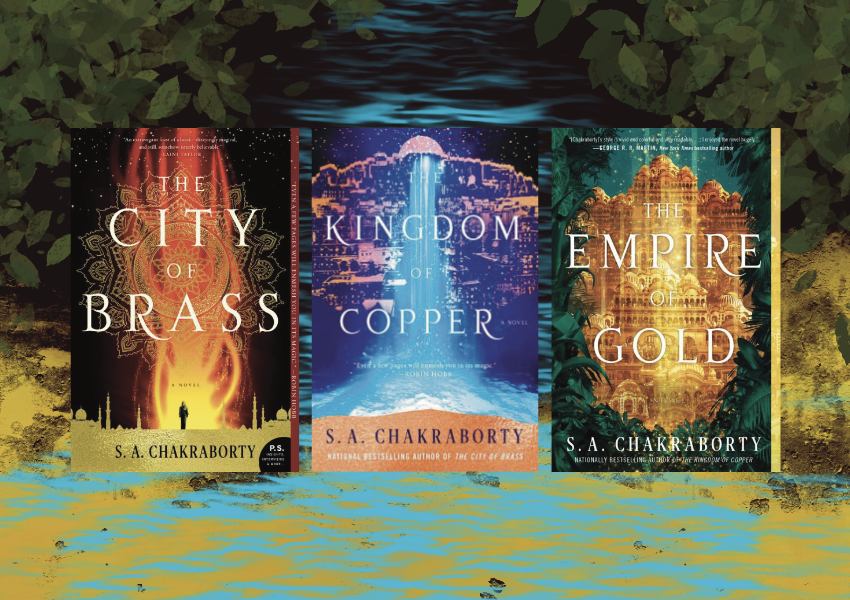
Title: The Daevabad Trilogy – The City of Brass, The Kingdom of Copper, and The Empire of Gold
Author: S.A. Chakraborty
Publisher: Harper Voyager
Publish Date: July 3, 2018 / September 24, 2019 / July 13, 2021
Genre: Adult Fantasy
Pages: 576 / 656 / 816
Format: Paperback
Nahri has never believed in magic. Certainly, she has power; on the streets of eighteenth-century Cairo, she’s a con woman of unsurpassed talent. But she knows better than anyone that the trades she uses to get by—palm readings, zars, healings—are all tricks, sleights of hand, learned skills; a means to the delightful end of swindling Ottoman nobles and a reliable way to survive.
But when Nahri accidentally summons an equally sly, darkly mysterious djinn warrior to her side during one of her cons, she’s forced to question all she believes. For the warrior tells her an extraordinary tale: across hot, windswept sands teeming with creatures of fire, and rivers where the mythical marid sleep; past ruins of once-magnificent human metropolises, and mountains where the circling birds of prey are not what they seem, lies Daevabad, the legendary city of brass—a city to which Nahri is irrevocably bound.
In Daevabad, within gilded brass walls laced with enchantments, behind the six gates of the six djinn tribes, old resentments are simmering. And when Nahri decides to enter this world, she learns that true power is fierce and brutal. That magic cannot shield her from the dangerous web of court politics. That even the cleverest of schemes can have deadly consequences.
After all, there is a reason they say to be careful what you wish for . . .
I’ve wanted to read this trilogy for years because I knew I would love it, but I put it off for a long time because I was afraid I wouldn’t love them. Well, I did, and I’m here to gush about this lush, thrilling, beautiful trilogy.
Set in Cairo, Egypt at the beginning of our story, we follow Nahri, a commonplace thief, hustling her business on the city streets of Cairo. Until one day she accidentally summons a djinn, Dara – a magical being of legend. The story picks up from there where it follows her, as well as a prince of the legendary djinn city – Daevabad. I wasn’t expecting a dual POV in this story, but I think that it really heightened it to a new level being able to see the world through two very different perspectives. We get to see Nahri learn of her ancestry, of how she has magic in her veins, and of how she is believed to be the last of her kind of daeva; as well as following Ali, the youngest of three royal siblings, who has pure intentions and a good heart, but chaos seems to follow him wherever he goes.
The world building in this tale was gripping and beautiful, as Chakraborty describes Cairo in the height of the French/Ottoman occupations, as well as across the seas to Daevabad, a massive city built upon an island. I felt that the descriptions were rich, and I was very easily able to immerse myself in the story, picturing what places like the midan (marketplace), the palace, and even the city walls looked like. From rolling hills and cliffsides, to scorching deserts and unforgiving ocean waters, I felt that I could imagine these places while Nahri and Ali traveled through them. Throughout the story, we get to see various places, and each description left me wanting to visit these places myself, even if they are just fantasy.
The characterizations as well were really well done, in my opinion. Each primary character felt distinct, and even those that weren’t on the page for long felt human and real. From a stubborn woman looking out for her own skin, to a genuinely well intentioned but naive young man, to a very easy to hate yet understand king, there is nothing short of amazing characters within this story. Chakraborty takes the time to dive into the history of these characters – not in a boring or overdone way, mind you, but as an integral part of the story. All of these moments helped to flesh out the overarching story, and it’s been some of the best character work I’ve seen to date.
There’s also plenty of action, and Chakraborty doesn’t pull punches when it comes to the violence that war can bring, that cruelty can bring. It can be devastating at times, and frustrating, but it all helped to further the story, or to be able to better understand the motivations of characters. I felt like the scenes were done well and fast, lingering just long enough to understand what was happening while knowing that war isn’t just a centralized point, but one that can happen across an entire city.
The magic of the world felt a bit elusive, but to my understanding it’s just magic that djinn, peris, and marid (creatures of fire, air, and water, respectively) are able to just conjure and use, that it doesn’t require any additional sacrifice or consequences, which was interesting to see. Magic wasn’t used too terribly often in the story from what I read, but what was seen was very cool and oftentimes large in scope, especially in the second and third books.
These books were heavy on the politics, which I personally loved. It delved into what it meant to be a ruler and leader to the king – even if others disagreed with him – as well as what being brought into a situation like Nahri was brought into meant for someone who was the last of her particular magic. There was scheming, lies, deceit, and more. I honestly felt like the politics were well done, and that they felt visceral and real, especially given the plot.
I only had a few small gripes that weren’t even that big in the scope of things (that I can’t talk about due to spoilers lol), and I did notice some typos, especially in book three, but overall these books were amazing. I haven’t felt so much love for individual books and for a series in a very long time. If you’ve been considering reading this trilogy, please, please pick it up. You won’t regret it.
If you love politics, magic, light romance, Middle Eastern inspired, great characterization types of books, then I believe you’ll love this trilogy.
Ratings Per Book
The City of Brass: ★★★★★ (5 stars)
The Kingdom of Copper: ★★★★★ (5 stars)
The Empire of Gold: ★★★★★★ (6 stars)